How to lose weight in a way you can keep up: the principles first, then the plan
Key takeaways
- Eat less energy than you use, losing about 0.5 kg a week, at most 0.75% of body weight
- Eat 1.6 g of protein per kg of target weight, and sleep 7 hours or more a night
- Do 150–300 minutes of moderate activity a week, plus strength training on at least 2 days
How to lose weight comes down to one rule that every working method follows: give your body a little less energy than it uses. Aim for about 0.5 kg a week but no more than 0.75% of your body weight, eat enough protein, sleep 7 hours or more, and move for at least 150 minutes a week as the World Health Organization recommends. Losing slowly in a way you can keep up gives you a better chance of keeping the weight off than a short, hard diet.
In this guide (6 sections)
- How to lose weight: where do you start, and why does energy balance matter?
- How much weight can you safely lose per week?
- How much protein do you need to lose weight, and why does it matter?
- Does poor sleep really make weight loss harder?
- If you control your diet, do you still need to exercise?
- Why does weight come back after a diet, and how do you prevent it?
How to lose weight: where do you start, and why does energy balance matter?
Every weight loss method that works does the same thing: you take in less energy from food than your body uses, so your body draws on its stored energy and your weight slowly goes down. No food burns fat from one specific spot.
The energy you use each day, called TDEE, is your basic energy use at rest (BMR) plus the energy you use moving around and exercising. We explain it in how many calories per day, or you can get your own numbers from our TDEE calculator (the page is in Thai).
Popular diets are tools that help you eat less. Choose the one you can keep up the longest.
| Popular method | Why it can work | What to watch |
|---|---|---|
| Cutting rice and carbs | Less total energy per meal | If you replace it with fried food or sweets, the total does not drop |
| Intermittent fasting (IF) | A shorter eating window often means eating less | Eating extra during the window cancels it out |
| Eating “clean” | Less oil and sugar, more vegetables and protein | You can still overeat clean food, so watch portions |
| Counting calories | Clear numbers, easy to adjust | Tiring if you count every bite forever |
As you lose weight, your body also uses less energy. Work by Kevin Hall and colleagues in The Lancet (2011) explains why weight loss slows over time instead of following a straight line. When your weight changes a lot, recalculate your numbers.
How much weight can you safely lose per week?
A good target for most people is about 0.5 kg a week, but no more than 0.75% of your body weight. If you want to go faster, stay at or below 1 kg or 1% of your body weight a week. The US Centers for Disease Control and Prevention (CDC) says people who lose weight gradually, about 1–2 pounds (roughly 0.5–1 kg) a week, are more likely to keep it off than people who lose it quickly.
| Current weight | Standard pace per week | Fastest pace per week |
|---|---|---|
| 55 kg | about 0.41 kg | about 0.55 kg |
| 65 kg | about 0.49 kg | about 0.65 kg |
| 75 kg | about 0.5 kg | about 0.75 kg |
| 85 kg | about 0.5 kg | about 0.85 kg |
| 100 kg | about 0.5 kg | about 1 kg |
Whichever pace you pick, do not go below 1,200 kcal a day for women or 1,500 kcal a day for men. In the first weeks the scale may drop faster than the table, partly because of water. There is no need to speed up.
You also do not need to reach your dream weight to see benefits. The CDC notes that losing about 5% of your body weight may lower the risk of some chronic diseases, such as heart disease and type 2 diabetes.
How much protein do you need to lose weight, and why does it matter?
While losing weight, you need more protein than usual, because it helps you feel full and protects your muscle. Thailand's Department of Health recommends about 1 g per kg of body weight for the general public. A review by Leidy and colleagues in the American Journal of Clinical Nutrition (2015) found that 1.2–1.6 g per kg a day, with about 25–30 g per meal, helped with appetite and weight control.
Our calculator uses 1.6 g per kg of target weight for weight loss. If your target is 60 kg, that is about 96 g of protein a day, or roughly 32 g per meal over 3 meals. For more on choosing and spreading protein, read protein for weight loss.
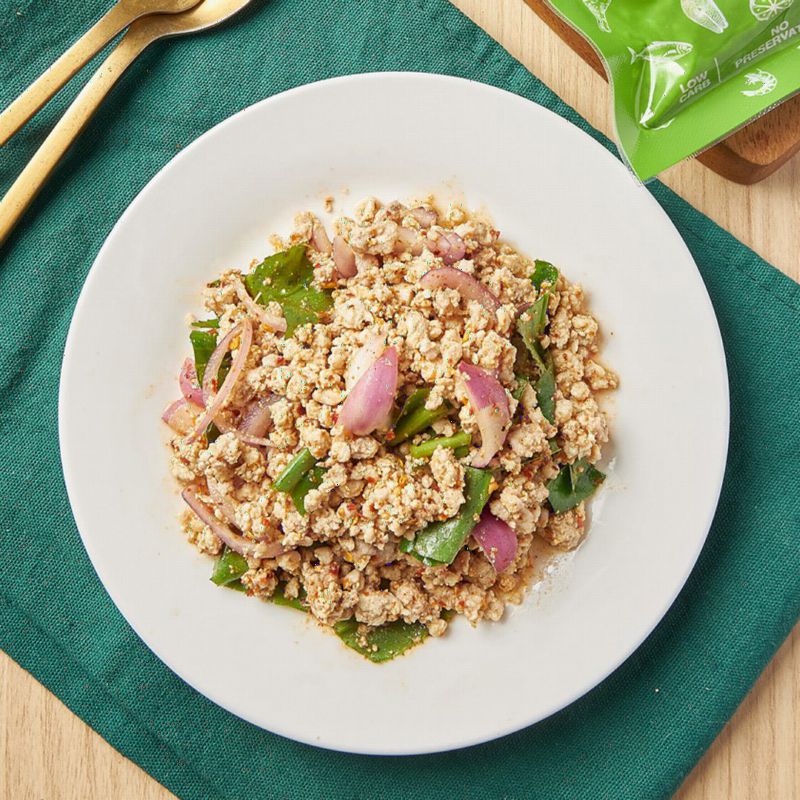
Examples of dishes with around 30 g of protein in one meal, from the CleanFit menu: Chicken Teriyaki at 190 kcal and 34 g protein, Ka Pow Kai at 180 kcal and 33 g protein, and Grilled Chicken with Garlic Sauce at 160 kcal and 32 g protein. Every dish is a main dish without rice.
Does poor sleep really make weight loss harder?
The evidence says yes. The American Academy of Sleep Medicine and the Sleep Research Society recommend that adults sleep 7 hours or more a night on a regular basis, and they link sleeping less than that with weight gain and obesity.
In a study by Nedeltcheva and colleagues in the Annals of Internal Medicine (2010), 10 overweight adults ate the same reduced-calorie diet for 14 days. With 8.5 hours of sleep they lost about 1.4 kg of fat. With 5.5 hours they lost only about 0.6 kg of fat, lost more non-fat mass and felt hungrier. The study was small, but it fits the advice above.
- Go to bed and wake up at about the same time every day, weekends included
- Skip coffee and tea in the late afternoon if you have trouble sleeping
- Do not eat a dinner so heavy you feel uncomfortable, or go to bed so hungry you cannot sleep
If you control your diet, do you still need to exercise?
Do both, because they help in different ways. Food is the easier way to control your energy numbers. Exercise protects your muscle, supports your heart, and helps you keep the weight off afterwards.
The World Health Organization (WHO) 2020 guidelines recommend that adults:
- Do 150–300 minutes a week of moderate activity, such as brisk walking or cycling, or 75–150 minutes of vigorous activity, such as running
- Do muscle-strengthening activities for all major muscle groups on at least 2 days a week
If you do not exercise yet, start with 10–15 minutes of brisk walking a day. The WHO also stresses that some activity is better than none. Add more time as your body gets used to it.
Why does weight come back after a diet, and how do you prevent it?
Regaining weight is very common. A meta-analysis of 29 studies by Anderson and colleagues in the American Journal of Clinical Nutrition (2001) found that more than half of the lost weight came back within 2 years, and more than 80% within 5 years. The usual reasons are:
- The method was too strict to continue, so people went back to their old way of eating
- A lighter body uses less energy, but people go back to eating the same amount as before
- Muscle was lost during the diet because of too little protein and no strength training
The way to prevent it is to make the way you eat while losing weight close to a way you can eat for good. Lose slowly, as in the table above, eat enough protein, train your muscles, weigh yourself once a week, and when you reach your goal, raise your calories step by step to maintenance level. If you are just starting, see the first-week steps in diet for beginners and how to choose food in weight loss food.
It also helps to know the numbers for what you eat without weighing everything yourself. All 38 CleanFit dishes show calories and protein for each meal. Each is a main dish without rice, frozen in a vacuum-sealed pouch, and keeps for 120 days in the freezer. Every dish is made with no cooking oil, no MSG, no added sugar and no preservatives, is Thai FDA approved, and has lab-tested nutrition.
Frequently asked questions
What is the fastest safe rate of weight loss?
No more than 1 kg or 1% of your body weight a week, and no less than 1,200 kcal a day for women or 1,500 kcal for men. The faster you go, the harder it is to keep going.
Can I lose weight without exercise?
Yes, if you eat less energy than you use. Exercise still helps protect your muscle and keep the weight off, so it is worth starting, even with a short daily walk.
Why did my weight drop at first and then stall?
A lighter body uses less energy, so the gap between what you eat and what you use gets smaller. Portions also tend to creep up. Recalculate with your current weight and write down what you eat for 3–4 days.
Do I have to give up rice to lose weight?
No. Control the amount instead. One ladle (thapphi) of steamed rice has about 80 kcal according to the Thai Food Exchange Lists, so you can adjust how many ladles fit your calorie target.
Is intermittent fasting better than normal calorie control?
IF is another way to time your meals. It works because it helps you eat less. If you eat extra during your eating window, you will not lose weight, so choose the method you can keep up.

Written by the CleanFit teamCalories and protein for each CleanFit dish come from our ordering system. Figures for other foods cite the sources named in the guide.
Want to try a pack?
Choose every meal yourself, from ฿44 per meal. Every meal shows its calories and protein, and we deliver across Thailand.