Healthy food list: what to eat from the 5 food groups, every day
Key takeaways
- Healthy food means all 5 food groups, lightly processed and boiled, steamed, grilled or baked
- Working women should aim for 6 scoops of vegetables and 4 fruit servings daily, within the 6:6:1 rule
- Use a 2:1:1 plate at each meal: 2 parts vegetables, 1 part starch and 1 part lean protein
A healthy food list is simply foods from all 5 food groups that are lightly processed and cooked by boiling, steaming, grilling or baking: brown rice, colorful vegetables, fresh fruit, fish, chicken breast, eggs, tofu, beans and plain milk. Thailand's Department of Health nutrition flag suggests that working women eat 8 scoops of rice or starch, 6 scoops of vegetables, 4 servings of fruit, 6 tablespoons of meat and 1 glass of milk a day, and keep sugar, oil and salt within its 6:6:1 rule.
In this guide (6 sections)
- What is on a healthy food list? Start with the 5 food groups
- How much of each food group should you eat per day?
- How do you build a healthy plate without weighing anything?
- Eating out in Thailand: which dishes are the healthier picks?
- No time to cook: what healthy options do you have?
- What are the common myths about healthy food?
What is on a healthy food list? Start with the 5 food groups
Healthy food means all 5 food groups, in sensible amounts, with little processing. No single food does everything. What matters is the overall pattern across the day and the week.
| Group | Choose often | Eat less |
|---|---|---|
| 1 Protein | Fish, chicken breast, eggs, tofu, dried beans, lean pork | Sausages, moo yor, bacon, pork belly, fried meat |
| 2 Rice and starch | Brown rice, corn, sweet potato, wholewheat bread | Sweet breads, pastries, sugar, crunchy packet snacks |
| 3 Vegetables | Leafy greens, pumpkin, carrots, mushrooms, broccoli, local greens | Battered fried vegetables, vegetables in thick coconut curries |
| 4 Fruit | Fresh seasonal fruit, such as guava, orange, papaya, banana | Fruit juice, candied or syrup-soaked fruit |
| 5 Fat | Small amounts of fat from nuts, sesame, fish and vegetable oil | Rich coconut milk, reused frying oil, lard, cream |
Plain milk belongs to group 1 and gives you both protein and calcium. If you do not drink milk, the nutrition flag suggests small fish eaten with the bones or firm tofu instead.
How much of each food group should you eat per day?
Thailand's Department of Health uses a nutrition flag to show how much to eat each day, by energy level. Working women aged 25–60 use the 1,600 kcal level, and working men the 2,000 kcal level. Amounts are in Thai household measures: a scoop is the rice ladle (ทัพพี), and a tablespoon is an ordinary eating spoon.
| Food group | Unit | Working women (1,600 kcal) | Working men (2,000 kcal) |
|---|---|---|---|
| Rice and starch | scoop | 8 | 10 |
| Vegetables | scoop | 6 | 5 |
| Fruit | serving | 4 | 4 |
| Meat, beans, eggs | tablespoon | 6 | 9 |
| Milk | glass | 1 | 1 |
| Oil, sugar, salt | teaspoon | As little as needed | As little as needed |
For the bottom layer, the Department of Health uses a 6:6:1 rule: no more than 6 teaspoons of sugar, 6 teaspoons of oil and 1 teaspoon of salt a day, with sodium under 2,000 mg. The World Health Organization (WHO) recommends at least 400 g of fruit and vegetables a day.
How do you build a healthy plate without weighing anything?
Use the Department of Health's 2:1:1 plate. Divide your plate into 4 parts: 2 parts vegetables, 1 part rice or starch and 1 part lean protein, then finish with a small plate of fruit that is not too sweet. Do this at each meal and your day lands close to the nutrition flag without counting.
How food is cooked matters as much as what it is. The same piece of chicken breast picks up extra calories from batter and oil once it is deep-fried. A simple order of preference:
- Often: boiled, steamed, grilled, baked, Thai salads (yam), blanched, curries without coconut milk
- Fine if light on oil: stir-fried
- Now and then: deep-fried, thick coconut curries, dishes with lots of sweet sauce or mayonnaise
Also watch the sauces on the table. Fish sauce, soy sauce and many dipping sauces are major sources of sodium. Taste before you season, and dip rather than pour over the whole plate.
Eating out in Thailand: which dishes are the healthier picks?
Almost every Thai food stall has a better option. Look for protein, vegetables, little oil and milder seasoning. Calories vary a lot by shop and portion, so treat this as a guide.
| Where | Pick | Go easy on |
|---|---|---|
| Made-to-order (ahan tam sang) | Stir-fried vegetables with meat, clear soup (tom jued), sour curry (kaeng som), ask for less oil, boiled egg instead of fried egg | Deep-fried dishes, omelette, crispy pork, big plates of fried rice |
| Noodle shop | Clear broth, extra vegetables, extra meatballs or lean meat | Crispy pork fat, finishing all the broth, adding sugar |
| Som tam and Isan food | Grilled chicken without skin, larb, nam tok, som tam that is not too sweet, a modest portion of sticky rice | Fried pork, fatty grilled pork neck, very sweet som tam |
| Rice and curry shop | 1 curry without coconut milk plus 1 stir-fried vegetable dish | Several coconut curries on one plate, fried items |
| Suki and shabu | Clear broth, lots of vegetables, lean meat | Several cups of dipping sauce, many packs of noodles |
For phrases to use when ordering and which made-to-order dishes to choose, read made-to-order Thai food for weight loss. On days when you rely on a convenience store, see healthy food at 7-Eleven.
No time to cook: what healthy options do you have?
You can eat well while working full days if you have ready food waiting before you get hungry. The main options:
- Meal prep on your day off: cook once and portion it out. How to do it and how long it keeps is in meal prep
- A daily tiffin subscription, if someone is home to receive food at set times. Compare it in healthy tiffin delivery vs frozen packs
- Frozen meal packs: keep them in the freezer and heat one meal at a time
- A convenience store, for emergencies, if you know how to read labels
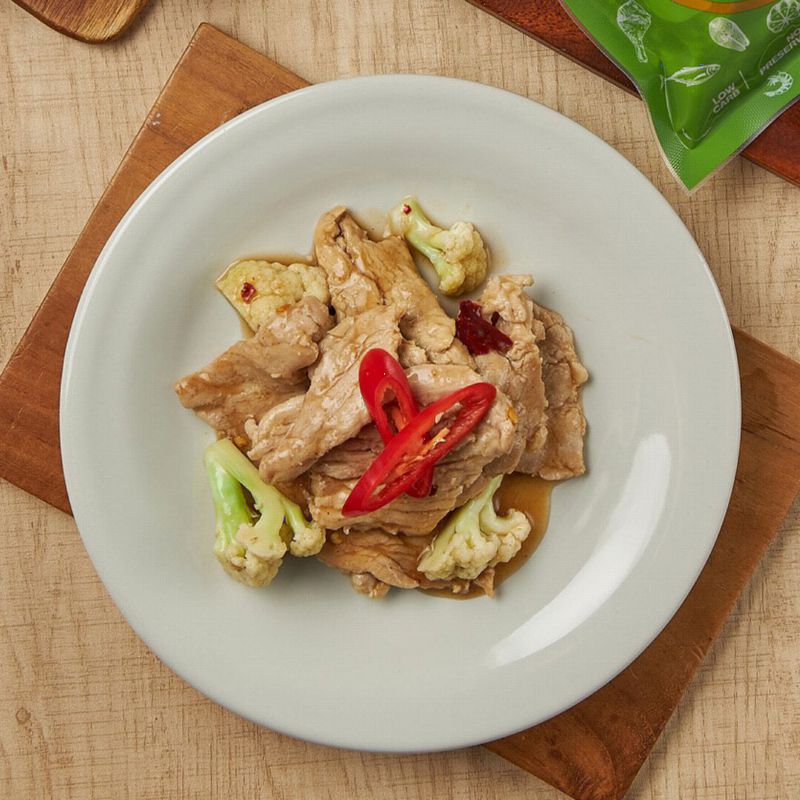
CleanFit is the frozen, ready-to-heat kind. There are 38 dishes with chicken, pork, noodles, fish and shrimp. Every dish shows its calories and protein, from 70 to 330 kcal with up to 34 g of protein, and you choose every meal yourself. Meals keep for 120 days in the freezer. Each one is the main dish only, with no rice, so you add brown rice and vegetables to complete a 2:1:1 plate. Every dish is made with no cooking oil, no MSG, no added sugar and no preservatives, is Thai FDA approved, and has lab-tested nutrition.
What are the common myths about healthy food?
Many people give up because they think healthy eating has to be complicated. Here are the beliefs we hear most.
- You have to cut out rice. The nutrition flag makes rice and starch the largest group. Choose unpolished rice and keep portions sensible
- Fruit juice is as good as fruit. WHO counts the sugar in fruit juice as free sugar to limit. Whole fruit is the better choice
- You can eat as much healthy food as you like. Calories still count. Eat more than you use and your weight can go up
- Healthy food has to be bland. Herbs, chili, lime and garlic add plenty of flavor without much sugar or oil
- Anything labelled clean or healthy is low in calories. Always check the nutrition label
For the basics, read what is clean food. If you would like a freezer stocked with ready dishes, packs on the website start at 21 meals, from ฿44.3 to ฿50 per meal on average.
Frequently asked questions
Is healthy food the same as clean food?
They are very close. Both focus on lightly processed ingredients and mild seasoning. Clean food usually stresses cooking with little oil and few condiments, while healthy food looks at the bigger picture of eating all 5 food groups in the right proportions.
How many vegetables should I eat a day?
The Department of Health nutrition flag suggests 6 scoops a day for working women and 5 for working men, where 1 scoop of cooked vegetables is one unit. Mix different colors through the week.
What is the 6:6:1 rule?
It is the Thai Department of Health's daily guide: no more than 6 teaspoons of sugar, 6 teaspoons of oil and 1 teaspoon of salt.
Is eating healthy in Thailand expensive?
Not necessarily. Rice, eggs, tofu, fish and seasonal produce are easy to find at markets. Costs usually climb when you buy meal by meal without a plan, so planning the week's meals ahead helps keep the budget down.
How can I eat healthy if I have no time to cook?
Have ready food in place before you get hungry: meal prep on your day off, a tiffin subscription, or frozen dishes with nutrition information. Then add rice and vegetables yourself to complete the plate.

Written by the CleanFit teamCalories and protein for each CleanFit dish come from our ordering system. Figures for other foods cite the sources named in the guide.
Want to try a pack?
Choose every meal yourself, from ฿44 per meal. Every meal shows its calories and protein, and we deliver across Thailand.